
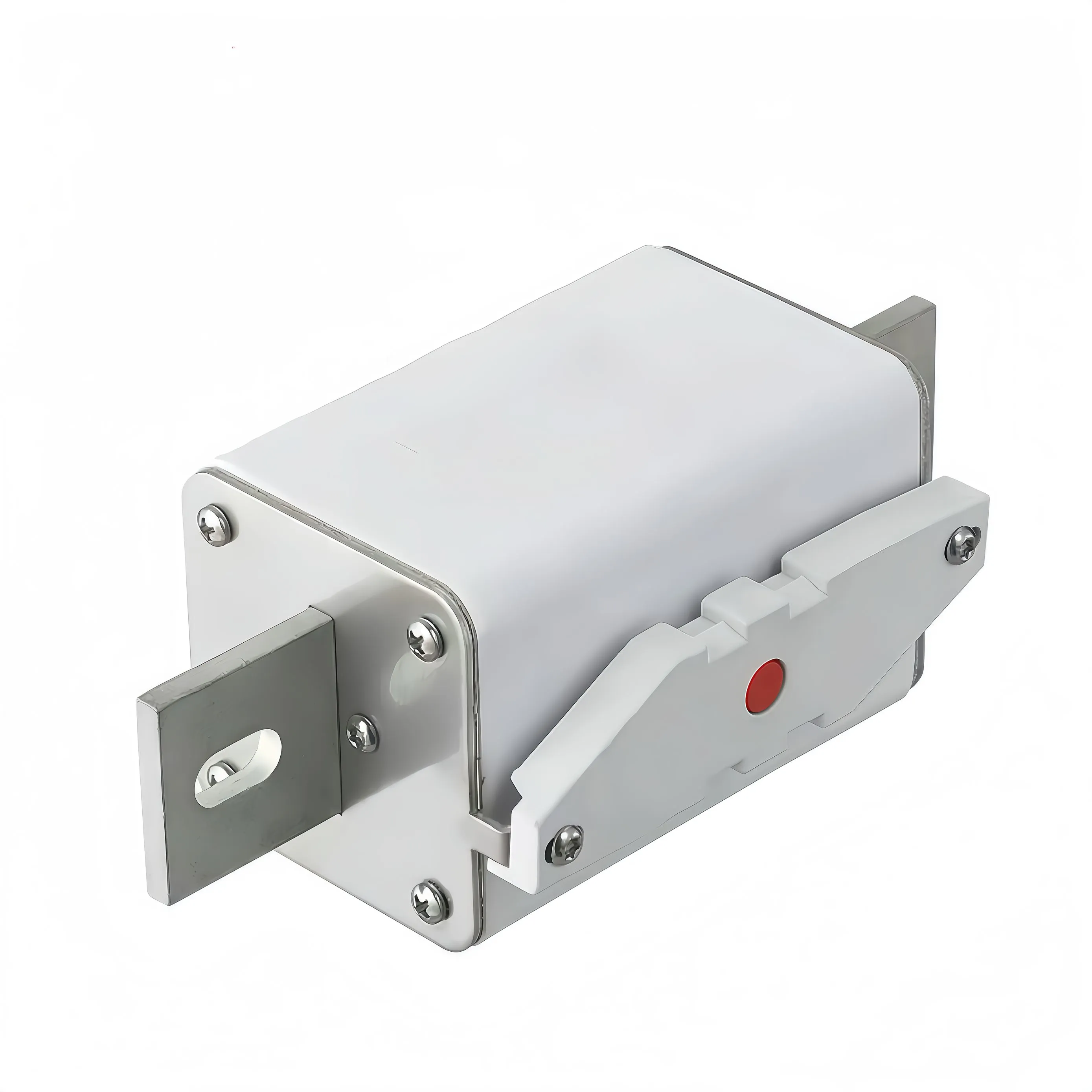
Solar protection is selected from two numbers printed on the module label, and those two numbers are almost always the wrong ones to start from. Installers reach for the nameplate power or the maximum power current, and the resulting PV fuse is either undersized and nuisance-blowing on the first hot week, or oversized and doing nothing when a string fault actually occurs. The two values that matter are Isc, the short-circuit current, and Voc, the open-circuit voltage. This article explains how to turn them into a defensible fuse selection.
Start With Isc, Not With Imp
A module datasheet gives you several currents. Imp is the current at maximum power. Isc is the current when the terminals are shorted. Isc is always higher — typically by five to ten percent — and it is the correct starting point, because a fault is not a maximum-power condition. The sizing logic runs like this:
- Take the module Isc at standard test conditions
- Apply a safety factor for the fact that real irradiance can exceed 1000 W/m², particularly with cloud-edge enhancement and snow or water reflection
- Apply the same factor again for the possibility of a reverse-current contribution from parallel strings
- Compare the result with the rated current of the device
Standards practice lands on a continuous rating of roughly 1.56 times the string Isc for a typical gPV device. That figure is not arbitrary: it is the product of the two factors above, and it is why you will see it quoted across the industry. Use the number your standard requires and your datasheet supports rather than a number you have memorised.
Why the Safety Factor Exists
Two real phenomena drive it. The first is irradiance overshoot. Standard test conditions assume 1000 W/m², but a module mounted over light-coloured roofing, or one experiencing cloud-edge focusing, or one with snow reflection, can see irradiance above that level. Current scales almost linearly with irradiance, so a string rated at 11 A Isc can produce noticeably more in the right conditions. The second is reverse current. If a string develops a fault while its neighbours stay healthy, the healthy strings can drive current backwards through the faulted string. The protective device in that string now has to interrupt current it was never carrying in normal operation, and the magnitude depends on how many strings are paralleled into the same combiner box. This is why a device selected at exactly Isc will not last. It is being asked to carry more than Isc in conditions that happen every year.
Voc Sets the Voltage Rating, With a Temperature Twist
Voltage selection looks simpler than it is. The maximum system voltage — 1000 V or 1500 V on modern utility designs — is the ceiling, but it is not the whole story. The twist is temperature. Voc has a negative temperature coefficient: as cells get colder, open-circuit voltage rises. A string designed to sit at 1400 V at 25 °C can exceed 1500 V at the low end of its operating range. If the device is rated exactly at the nominal system maximum, a cold morning can push it beyond its rating. Good practice is to calculate the maximum cold-temperature Voc from the module's temperature coefficient and the lowest expected ambient temperature for the site, then select a device whose voltage rating exceeds that figure. For a 1500 V system this is precisely why the 1500 V rating exists rather than a 1000 V device with "some margin". There is a second reason not to compromise on voltage. DC arcs do not self-extinguish at a zero crossing, so the voltage rating describes arc-quenching capability. A device operated above its rating may not clear at all.
The Reverse-Current Case in Detail
Consider a combiner box with eight strings. One string develops a fault. The other seven, all healthy and all energised, drive current into the fault through the combiner busbar. The device in the faulted string must interrupt that combined contribution. The calculation is simple: sum the Isc of the other strings, and verify that the device's breaking capacity comfortably exceeds the result, at the system voltage, with the appropriate time constant. This is the case that catches people out, because it is easy to check the device against its own string current and forget about its neighbours. It is also the case that matters, because it is the scenario the protection was actually installed for.
Temperature Derating Inside the Combiner Box
Solar protection devices live in hot places. A combiner box on a roof in summer can easily reach 60 °C or more internally, and an enclosure in direct sun at altitude is worse. Continuous current capability falls as ambient temperature rises, and every manufacturer publishes a derating curve. Read it at the actual worst-case internal temperature, not at the 25 °C reference condition, and not at the outdoor ambient. If the derated capability drops below the calculated string requirement, you have two honest options: move up a rating, or improve the thermal situation — shading, ventilation, or relocating the enclosure. Burying the problem by ignoring derating produces exactly the intermittent summer failures that are hardest to diagnose, because the system behaves perfectly for nine months of the year.
What to Check on the Datasheet
Before you commit, confirm all of the following:
- Rated current, checked against Isc with the required safety factor and derating applied
- Voltage rating, checked against cold-temperature Voc rather than nominal system voltage
- Breaking capacity, checked against the reverse-current contribution from parallel strings
- Class designation, with gPV being the category intended for photovoltaic applications
- Operating temperature range and the derating curve
- Certifications relevant to your market, and compliance with RoHS and REACH where required
- Physical compatibility with the holder, including the correct fuse body size
Summary
Match current to Isc with the standard safety factor and the enclosure derating applied, match voltage to cold-temperature Voc rather than nominal system voltage, and match breaking capacity to the reverse-current contribution from the other strings in the box. Those three checks, done in that order, cover essentially every field failure we are asked to investigate.
About Our Photovoltaic Protection Range
GFEFUSE is the brand of Dongguan Gongfu Electronics Co., Ltd., an electronic protection device manufacturer founded in Dongguan, Guangdong in 2013. We develop, produce, and sell fuses, fuse holders, and fuse boxes, with five advanced production lines and thirteen R&D engineers, and our products are exported worldwide. Our photovoltaic fuse range covers the DC protection requirements of string and central inverter designs, and it is normally paired with a matched holder from our fuse holder selection so that the body size, mounting style, and creepage distances are verified as a set rather than separately. Where a project combines solar with storage, our energy storage fuse range covers the battery side, and the high voltage fuse portfolio supports the rest of the DC chain. Products carry UL, cULus, TUV, CE, and CQC certification and comply with RoHS and REACH directives, serving new energy, power equipment, communication systems, automotive electronics, and consumer electronics.
Conclusion
String Isc and Voc are on the module label for a reason. They are the two numbers the protective device has to be matched to — with the safety factor for irradiance and reverse current, the derating for a hot enclosure, and the cold-temperature correction for voltage applied on top. Get those three corrections right and the selection will survive its first summer and its first winter.
Send us your string Isc, cold-temperature Voc, number of parallel strings, and enclosure temperature range. We will confirm the rating and the matched holder for your combiner box design.
Frequently Asked Questions
Practical answers to the questions we handle most often on photovoltaic protection.
How do I size a PV fuse for a solar string?
Start from module Isc, not Imp. Apply the safety factor required by your standard — commonly around 1.56 times Isc — then apply the manufacturer's derating curve at the worst-case internal temperature of the enclosure. Confirm the result against the device's continuous rating.
Can I use a 1000 V PV fuse on a 1500 V system?
No. Voltage rating in DC describes arc-quenching capability, and a 1000 V device has not been characterised for 1500 V interruption. Always select at or above the maximum cold-temperature Voc of the string.
Why does my PV fuse blow in hot weather?
Almost always a derating issue. Internal enclosure temperature in summer can be far above the reference condition, reducing continuous current capability. Check the derating curve at the actual worst-case temperature and consider ventilation or a higher rating.
What is reverse current and why does it matter?
When one string faults, the healthy parallel strings feed current backwards through it. The protective device in the faulted string must interrupt that combined contribution, which can be many times its own string current. Breaking capacity must cover this case.
Do I need a different fuse for rooftop and utility scale systems?
The sizing logic is the same, but the conditions differ. Rooftop enclosures often run hotter, while utility scale systems have more parallel strings and therefore larger reverse-current contributions. Both change the numbers, not the method.